
Grow your camp for gold and workers, and train sentries into riders and druids for power.
Rules
The Raven Order — Rule Summary
The Raven Order is a two-player strategy game about growing a small realm from a single camp, training riders and druids, and winning by tearing down every one of your rival's buildings.
Quick start
The 60-second version.
The fastest way to learn is by doing: play a guided match against the Raven AI — it walks you through your first turn. Prefer to read first? Here it is.
Every turn: harvest, then build, train, and play cards, then choose whether to attack.
A blocked attacker fights whichever defenders you assign to it; an unblocked one strikes a building of your choice directly.
Destroy every one of your opponent's buildings to win.
Overview
Balance gold and workers against the risk of war.
Each player grows their camp into a small empire, balancing gold and workers against the risk of war. Games are short, tense, and won by whoever times their strike best.
2 players
30 minutes
12+ years
Setup
Before the first turn.
- Shuffle the evolution cards into a deck.
- Each player receives a camp and 5 random evolution cards in hand.
- Roll a die to decide who goes first.
- The player who goes second receives 1 sentry to even out the start.
Turn flow
Three phases, every turn.
Once all three are complete, your opponent's turn begins.
Harvest phase
You get 1 worker. If you have a camp, town, and/or capitol, you get gold. If you have an academy level 3, you get 1 evolution card.
Construction phase
You may build one building, train any number of units, play any number of evolution cards from your hand, and sell any number of workers for 1 gold each.
War phase
You choose your attacking riders and druids. Your opponent assigns defenders to stop them (several defenders can gang up on one attacker), then the battle resolves.
Cards & combat
Battles & evolution cards
An attacker dies if its assigned defenders have at least as much power combined. In turn, the attacker kills defenders one by one until killing another would exceed its own power — you choose which ones fall. For example, a power-4 attacker stopped by two power-2 defenders kills both, but dies too, so all three units fall. If one of those defenders had power 3 instead, only that one would die.
An attacker nobody stops doesn't fight — instead it strikes a building of your choice. A building's resistance equals its gold cost, and it's destroyed once the attacking power reaches or exceeds that resistance. Two unstopped power-2 attackers can bring down a guildhall (4 gold) but not a town (5 gold). After the war phase, killed units and destroyed buildings are removed, and all other, nonlethal damage heals. Destroy every one of your opponent's buildings, and you win.
Any unit can defend, but attacking uses it up: once a unit attacks, it can't defend again until your next turn. Riders and druids can attack, but not on the turn they're trained.
Evolution cards stay hidden in your hand and are played on your own units or buildings during the construction phase, if the target is valid, you have the required academy level, and the target doesn't already carry a card. An evolution card played on a druid is called a tattoo; one played on a building has no special name. Either way, it's lost when its host is destroyed.
Reference
Buildings
One building per turn, gold up front, permanent effect once it's standing. You can only own one building of each type, and you may rebuild one after it's destroyed.

Camp
3 gold
+2 gold per turn
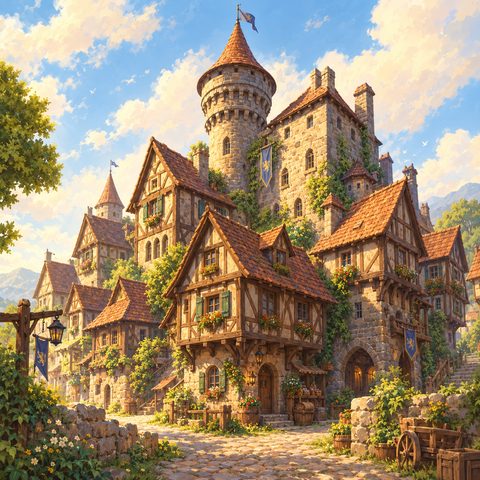
Town
5 goldRequires Camp
+2 gold per turn

Capitol
6 goldRequires Town
+3 gold per turn
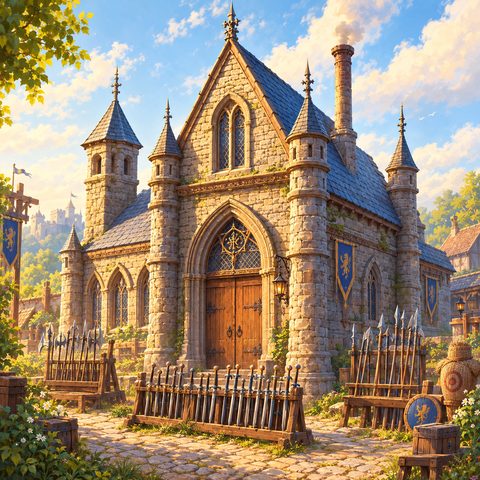
Armory
2 gold
Allows training sentries

Citadel
2 goldRequires Armory
Allows training riders

Shrine
2 goldRequires Citadel
Allows training druids

Academy Lv. 1
2 gold
Allows playing level 1 evolution cards

Academy Lv. 2
2 goldRequires Ac. Lv. 1
Allows playing level 2 evolution cards

Academy Lv. 3
2 goldRequires Ac. Lv. 2
Allows playing level 3 cards, +1 evolution card per turn
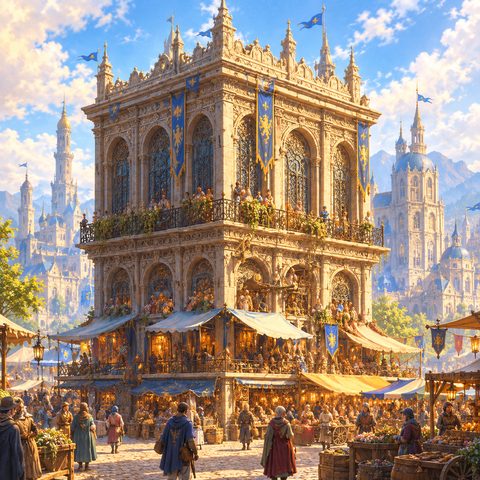
Guildhall
4 gold
+1 worker per turn
Reference
Units
Each unit trains from the one below it. A worker becomes a sentry, a sentry becomes a rider, a rider becomes a druid. Training a druid, for example, costs 1 worker and 3 gold in total, one step at a time.
Worker
Free0 power
Defend; sell for 1 gold; you receive 1 per turn
Sentry
1 gold2 power
Defend (trained from a worker)
Rider
1 gold2 power
Defend and attack (trained from a sentry)
Druid
1 gold2 power
Defend, attack, and receive a tattoo — an evolution card (trained from a rider)
Reference
Evolution cards
19 unique cards, 24 in the deck — the 5 druid tattoos below each appear twice. Cards that target a druid become a tattoo; the rest attach to a building.

Frost mark
DruidLv. 1
Whenever this druid is engaged in battle (stopping a unit or being stopped), all enemy units temporarily have −1 power.

Bloom mark
DruidLv. 1
+1 power. +1 worker per turn for each academy building you have more than your opponent (0–3).

Crown rune
DruidLv. 2
All your druids get +3 power, including this one.

Shadow rune
DruidLv. 2
+3 power; can only be stopped by druids.

Spirit emblem
DruidLv. 3
+4 power. Whenever it attacks or defends, kill one untattooed enemy unit for each academy building you have more than your opponent.

Canine
Academy Lv. 1Lv. 1
Whenever you attack, increase the power of one of your riders temporarily by +1 for each academy building you have.
Conquest
ArmoryLv. 1
Whenever you attack with at least two riders, you receive 1 worker for each academy building you have.

Looting
ArmoryLv. 1
Whenever any of your riders kill a worker or sentry, you receive 2 gold.

Horses
ShrineLv. 1
Your riders can attack the turn they are trained.

Poisons
ShrineLv. 1
After the battle, any units that were engaged in battle with one of your riders are killed.

Travelling
CampLv. 2
Training riders doesn't cost gold. Training druids costs +1 gold (a druid is still 1 worker and 3 gold total).
Squire
CampLv. 2
For each attacking rider that would be killed, you may kill one of your workers instead.

Corruption
GuildhallLv. 3
Take control of one enemy unit when played; it can't attack the turn it changes sides.

Dawn raid
CitadelLv. 3
Whenever you attack with at least one rider, you may kill one unit before defenders are chosen.

Rituals
CitadelLv. 3
Your riders have +1 power.

Medicine
GuildhallNo academy
You receive +1 worker and −1 gold per turn.

Shields
TownLv. 1
Whenever one of your sentries stops a rider, temporarily increase its power by +1.
Steel craft
CapitolLv. 1
Your riders have +2 power.

Cloaking
CapitolNo academy
Your druids can only be stopped by druids.